How to Coordinate Photographer Videographer on Wedding Day
Learn how to coordinate photographer videographer wedding day for flawless coverage. Capture every moment beautifully with expert tips!
July 9, 2026

Coordinating your photographer and videographer on your wedding day is the single most important logistics decision you will make for your visual memories. When photo and video teams work in sync, they capture every ceremony moment, every tearful speech, and every candid laugh without stepping on each other's shots. The industry term for this practice is "wedding media coordination," and it covers everything from pre-event planning calls to on-day positioning agreements. This guide covers the exact steps to coordinate photographer videographer wedding day coverage, from the first vendor meeting to the final reception dance.
How to coordinate photographer and videographer for your wedding day
The foundation of great wedding media coordination is early, deliberate planning. Coordination sessions should start 2–3 months before your wedding date. That window gives both teams enough time to align on shot lists, discuss equipment needs, and build a shared timeline before the pressure of the day arrives.
Starting early also prevents the most common coordination failure: two vendors showing up with conflicting assumptions. One team expects to lead the first look. The other has already planned a wide cinematic shot from the opposite angle. Without a prior conversation, both shots suffer. Early planning eliminates that conflict before it starts.
The first coordination step is a joint introduction meeting. Introduce your photographer and videographer to each other by email or video call. Give each vendor the other's contact information and ask them to connect directly. This single step shifts the coordination burden off your plate and onto the professionals.
Here is a practical sequence to follow:
- Book both vendors and confirm they have experience working alongside the other discipline.
- Share contact details between your photographer and videographer within one week of booking.
- Schedule a three-way planning call at the 2–3 month mark to align on the day's priorities.
- Build a shared shot list that both teams review and approve together.
- Distribute the finalized timeline to every vendor at least one month before the wedding.
Pro Tip: Ask each vendor directly: "Have you worked with the other team before?" Vendors who already know each other's working style move through the day faster and with far less friction.
What communication tools work best for wedding day coordination?
Clear communication is the mechanism that turns good planning into great execution. Using email, calls, planning apps, walkie-talkies, and hand signals covers every phase of coordination, from months-out planning to real-time adjustments during the ceremony.
Each tool serves a specific purpose:
- Email works best for formal documents: contracts, timelines, shot lists, and venue maps. It creates a written record both teams can reference.
- Video calls handle complex planning conversations where tone and visual cues matter. Use them for the main pre-wedding sync call.
- Group text threads keep the photographer, videographer, and you connected on the morning of the wedding for last-minute updates.
- Walkie-talkies or headsets allow instant updates between teams during the ceremony without disrupting guests.
- Silent hand signals let teams communicate across a crowded room without making noise or drawing attention.
A pre-wedding sync call between leads of the photo and video teams is the single most effective communication step you can take. That call covers shot priorities, preferred angles, and equipment placement. It prevents the most common on-day problem: one vendor's gear blocking the other's shot.
Pro Tip: Create a shared group chat the week before the wedding. Include your photographer, videographer, and wedding coordinator. Use it for weather updates, venue access times, and any last-minute changes to the schedule.

How do you build a shared timeline for photo and video coverage?
A coordinated timeline is the operational backbone of your wedding day. Sharing the timeline at least one month in advance keeps every vendor aligned on arrival times, equipment setup windows, and the sequence of priority moments.
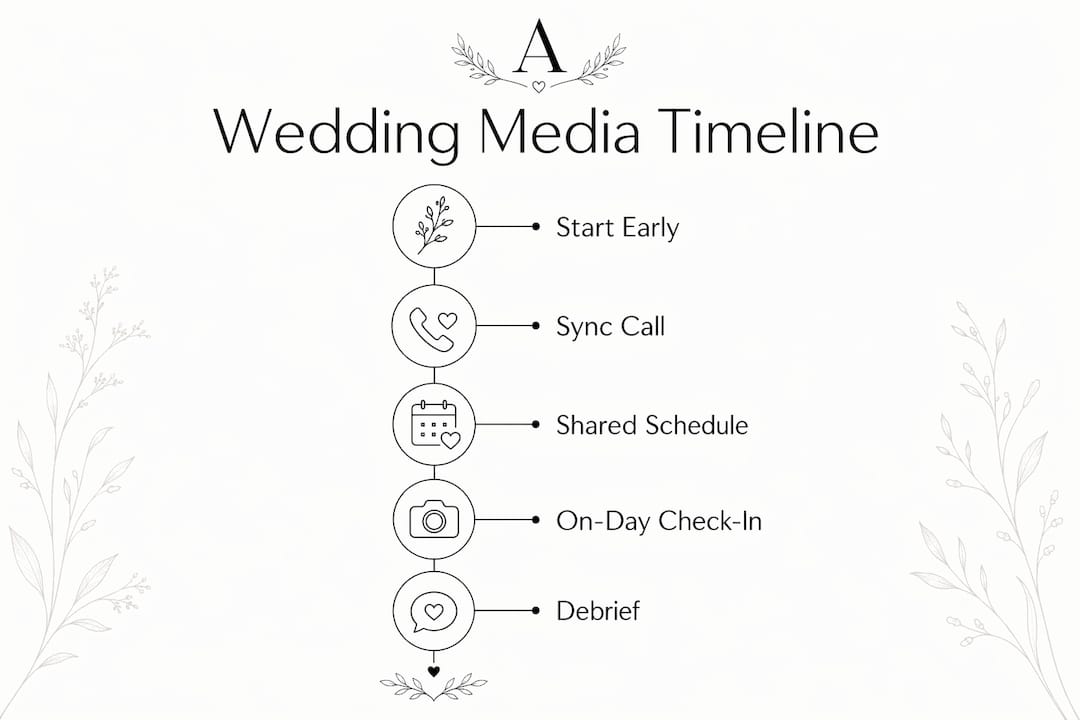
The timeline should go beyond a simple schedule. It needs to specify which moments are non-repeatable and therefore require both teams to be fully positioned and ready. The ceremony processional, the exchange of vows, the first kiss, and the first dance all fall into this category. Missing any of them is not recoverable.
Photographers typically lead during portrait sessions while videographers capture motion and reactions simultaneously. This division of roles keeps the timeline moving and prevents the couple from standing in one spot while two teams argue over angles. Agreeing on this structure in advance is what makes portrait sessions feel efficient rather than chaotic.
The table below shows a sample coordinated timeline structure for a typical wedding day:
| Time | Event | Photographer role | Videographer role |
|---|---|---|---|
| 10:00 AM | Vendor arrival and setup | Scout ceremony and portrait locations | Set up audio equipment and test levels |
| 12:00 PM | Getting ready coverage | Detail shots: dress, rings, shoes | Candid footage of preparation moments |
| 3:00 PM | Ceremony | Stationary angles at altar and aisle | Wide cinematic shots and close reaction footage |
| 4:30 PM | Portrait session | Directs couple and wedding party | Captures movement, laughter, and candid moments |
| 6:00 PM | Reception entrance | Documents formal entrance | Films crowd reactions and ambient energy |
| 8:00 PM | Speeches and first dance | Still images of speakers and couple | Continuous video with audio capture |
For a deeper look at building your wedding timeline, Ataviaweddings has published a detailed guide covering every phase from vendor arrival to last dance.
What on-day tactics prevent vendor conflicts during the wedding?
On-day coordination requires active management, not just good intentions from the morning briefing. The most effective tactic is a pre-ceremony walkthrough where both teams physically walk the venue together. Pre-ceremony walkthroughs allow teams to agree on tripod, microphone, and vendor placement, which prevents intrusions during key moments.
Practical on-day tactics that protect coverage quality:
- Assign quadrants at the ceremony. The photographer takes the left aisle angle; the videographer takes the right. Neither crosses into the other's primary zone without a signal.
- Flag audio equipment early. Microphone stands and wireless transmitters on the officiant and groom must be placed before guests arrive. Late placement disrupts the setup and appears in early photos.
- Use the "photographer leads, videographer follows" rule during portraits. The photographer directs poses; the videographer films the process and the in-between moments.
- Agree on a "hold" signal for moments when one team needs the other to pause movement. A raised fist or open palm works without making noise.
- Check in at every transition. Moving from ceremony to cocktail hour, and from portraits to reception, are the moments when vendors most often drift out of sync.
Experienced combined teams develop non-verbal shorthands that let them move through the day without interference. That efficiency comes from repetition, but you can replicate it with any two vendors through a thorough pre-day briefing.
Pro Tip: Ask your photographer and videographer to do a five-minute debrief at the start of cocktail hour. That check-in catches any coverage gaps before the reception begins and gives both teams a chance to reset priorities.
For couples who want to see how unified media teams tell stories, the difference between coordinated and uncoordinated coverage shows up clearly in the final product.
Key Takeaways
Effective wedding media coordination requires early planning, clear communication tools, a shared timeline, and active on-day management to produce complete, conflict-free coverage.
| Point | Details |
|---|---|
| Start coordination early | Begin formal planning 2–3 months before the wedding to align shot lists and timelines. |
| Use the right tools | Email handles documents; group texts and walkie-talkies manage real-time day-of updates. |
| Build a shared timeline | Distribute the finalized schedule to all vendors at least one month before the wedding. |
| Assign clear roles | Photographer leads portraits; videographer captures motion to keep the day moving. |
| Run a pre-ceremony walkthrough | Walk the venue together to agree on positioning before guests arrive. |
What 16 years of weddings taught me about vendor coordination
After working through over 1,600 weddings, the pattern is unmistakable: the couples who stress the least on their wedding day are the ones who treated vendor coordination as a planning priority, not an afterthought.
The biggest mistake I see is couples assuming that two professional vendors will "figure it out" on the day. They rarely do without a framework. Two talented people with different instincts and no prior conversation will default to protecting their own shot, not the other person's. That is not a character flaw. It is just human nature under pressure.
The pre-wedding sync call between photo and video leads is the single step that changes everything. I have watched that one conversation prevent a videographer's boom arm from appearing in every ceremony photo, and stop a photographer from standing directly in front of a camera during the vows. Neither vendor meant to cause a problem. They simply did not know where the other was planning to stand.
My advice to every couple is direct: do not wait for your vendors to coordinate themselves. Send the introduction email yourself. Schedule the three-way call. Ask both teams to share their equipment lists with each other. That level of advocacy takes 30 minutes of your time and saves hours of frustration in post-production when editors discover that half the ceremony footage has a camera bag in the corner of the frame.
The couples who get the best results treat their photographer and videographer as a team, not as two separate contractors. That mindset shift is what produces a final product that feels like a complete story rather than two parallel records of the same day.
— Atavia
How Ataviaweddings handles photo and video coordination for you
Planning a wedding is demanding enough without managing vendor logistics on top of it. Ataviaweddings brings over 16 years of experience and a portfolio of more than 1,600 weddings to every booking, which means the coordination framework is already built in.

Ataviaweddings' combo packages combine photography and videography under one team, which eliminates the most common source of on-day conflict: two separate vendors with no shared history. The team handles timeline planning, equipment positioning, and real-time communication internally, so couples arrive on their wedding day knowing every moment is covered. With 100% positive client feedback, the results speak for themselves. Visit Ataviaweddings to schedule a consultation and review available packages for your date.
FAQ
When should I start coordinating my photographer and videographer?
Start coordination 2–3 months before your wedding date. That window allows enough time for a joint planning call, shared shot list review, and timeline distribution at least one month before the event.
What is a pre-wedding sync call and why does it matter?
A pre-wedding sync call is a direct conversation between the leads of your photo and video teams to align on shot priorities, angles, and equipment placement. This call prevents vendors from blocking each other's shots or capturing intrusive gear during key moments.
Should I hire one team or two separate vendors?
Combined photo and video packages cost less and simplify logistics compared to hiring two separate vendors. They also provide better built-in coordination since the team already has an established working rhythm.
How do photographers and videographers avoid interfering with each other?
Pre-ceremony walkthroughs and non-verbal cues are the primary tools. Teams agree on positioning zones, equipment placement, and hand signals before the ceremony begins, which prevents real-time conflicts during non-repeatable moments.
What should a shared wedding day timeline include?
A coordinated timeline should list vendor arrival times, equipment setup windows, priority moments for both teams, and role assignments for each transition. Distributing this timeline at least one month before the wedding keeps every vendor aligned and reduces day-of surprises.
Recommended
Planning your wedding?
Atavia films and photographs weddings nationwide — local teams, no travel fees, and a $500 deposit reserves your date.
Reserve Your Date